
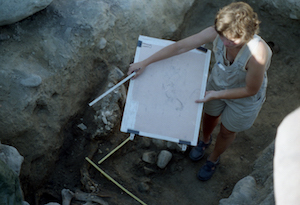
 Archaeology is a domain that has intersections with information research both as an empirical domain of investigation and as a perspective to inquire into how people interact with information. The relevance of discussing the links between the disciplines of information and archaeology relates to the increasing societal significance of cultural heritage around the globe.
Forthcoming presentations
Latest Publications
What a Standard Makes out of a Process? Data-documentation Standards and Their Consequences to Process Documentation
Huvila, I., Sköld, O., Zengenene, D., & Andersson, L. (2026). What a Standard Makes out of a Process? Data-documentation Standards and Their Consequences to Process Documentation. Journal of Documentation, 82, 289–314. http://doi.org/10.1108/JD-10-2025-0324 (Original work published 2026)
Habitats of Archaeological Knowledge: From Information Ecologies to Information-in-Ecologies
Huvila, I. (2026). Habitats of Archaeological Knowledge: From Information Ecologies to Information-in-Ecologies. In N. Solhjoo (Ed.), Multispecies Information Science (pp. 201–220). London: Routledge. http://doi.org/10.4324/9781003583424-15
Documenting AI Use in Humanities Research
Huvila, I. (2025). Documenting AI Use in Humanities Research. In H. Verhagen, S. Tienken, A. Widholm, M. Fridlund, M. Nermo, & A. Blåder (Eds.), Huminfra 2025 (pp. 57–62). Stockholm: Stockholm University.
Letting AI Loose in an Archive: Technology to Manage or to Manage With
Huvila, I. (2025). Letting AI Loose in an Archive: Technology to Manage or to Manage With. Archiv, Theorie & Praxis, 75, 12–15.
Researchers Data Processing Descriptions–Understanding Paradata Creation Practices and Their Underpinning Instrumentalities
Huvila, I., Andersson, L., & Sköld, O. (2025). Researchers Data Processing Descriptions–Understanding Paradata Creation Practices and Their Underpinning Instrumentalities. Journal of the Association for Information Science and Technology, 76(11), 1570–1590. http://doi.org/10.1002/asi.70003
Latest toots
 |  |  |  |